
Featured Industrial Replicas & Animatronic Systems
Engineered to academic and entertainment specifications, audited for rigorous structural and environmental resilience.
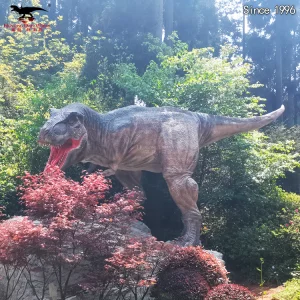
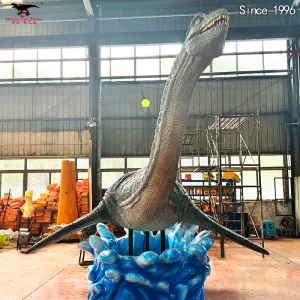
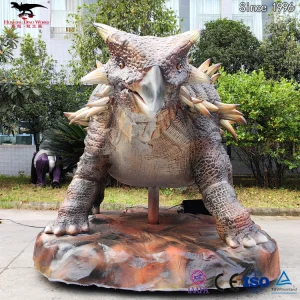
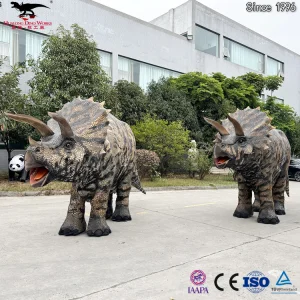
Years Manufacturing Heritage (Since 1996)
Export Destination Territories
Senior Structural & Bio-Mechanical Engineers
Paleontological Anatomical Accuracy Ratio
Industry Evolution: From Decorative Fossils to Precision Science Replicas
A paradigm shift driven by digital photogrammetry, computational biomechanics, and museum-grade composite material chemistry.
Historical Limitations (1990s–2010s)
Traditional dinosaur skeleton reproduction relied heavily on manual clay sculpts based on generalized illustrations. Early polyurethane and basic glass-fiber models suffered from severe structural brittleness, joint degradation, inaccurate bone-mass ratios, and lack of osteological micro-textures.
These early replicas presented massive structural liabilities for high-capacity public installations, often cracking under dynamic temperature shifts or failing local municipal structural load inspections.
High Simulation Technological Disruption
Today's High Simulation Dinosaur Skeleton engineering leverages high-precision optical 3D surface scanning, laser telemetry, and micro-CT reconstructions of holotype fossils directly accessed through academic collaborations.
Modern skeletons integrate internal aircraft-grade structural steel trusses hidden completely within hollow, high-density polymer matrices, offering verified seismic resistance, modular assembly joints, and micrometric osteological precision.
Commercial Value & ROI Realization
Global entertainment developers and museum boards recognize that scientific authenticity drives extended visitor dwell time and higher gate premiums. A museum-grade fossil replica anchors retail atriums and scenic environments into immersive educational destinations.
Engineered skeletons reduce operational lifecycle costs through UV-stabilized resins, anti-corrosive internal structural skeletons, and detachable sub-assemblies that minimize transport damage and freight expense.
Global Enterprise Procurement Requirements
Cross-sector sourcing requirements across scientific curation, entertainment engineering, and experiential commercial architecture.
Natural History & Academic Museums
Demands zero tolerance for anatomical conjecture. Replicas must mirror holotype specimens down to pneumatic foramina, bone density texturing, and authentic articular surfaces. Sourcing directors prioritize non-destructive mounting armatures that facilitate scientific research and loan exhibitions.
Theme Parks & FEC Developers
Requires extreme mechanical durability, wind/vibration load tolerance for outdoor displays, and ASTM/EN71 safety standard compliance. Must withstand public contact, high moisture environments, and dynamic lighting thermal variations while maintaining structural integrity over decades of continuous use.
Commercial Retail & Real Estate Hubs
Requires high aesthetic visual impact, lightweight structural properties for overhead atrium suspension, fire-retardant structural certification (class B1/A2), and accelerated delivery schedules to meet strict seasonal grand opening timelines.
Industry 4.0 & Supply Chain Resilience in Zigong
The convergence of deep local geological heritage, precision metal engineering, and modern digital manufacturing infrastructure.
The Zigong Industrial Ecosystem
Located in the heart of Sichuan's historic paleontological excavation basin, Zigong produces over 85% of the world's simulation dinosaurs and skeletal models. This density concentrates master paleo-sculptors, mechanical automation suppliers, and composite material polymer labs within a 30-kilometer perimeter.
This geographic concentration creates unmatched supply-chain elasticity, enabling rapid raw material aggregation, rapid prototyping, and specialized metallurgical fabrication that traditional overseas workshops cannot duplicate at scale.
Structural Precision & Digital Metallurgy
Our Industry 4.0 production bases integrate fully automated laser pipe cutters, robotic multi-axis seam welders, and finite element stress analysis (FEA). Internal load-bearing armatures are engineered from Q235 structural steel with multi-tier anti-rust hot-dip galvanization.
Each bone segment is molded from high-impact unsaturated polyester resins or ultra-lightweight fiberglass composites reinforced with alkali-resistant mesh, achieving high tensile resistance while minimizing suspended ceiling loads.
Rigorous QA/QC & Environmental Auditing
Every skeletal articulation system undergoes continuous static load-bearing and seismic deflection testing for a minimum of 48 hours prior to crating. Skeletons destined for coastal regions receive proprietary marine-grade epoxy coatings to prevent salt-fog pitting.
Full CE, ISO9001, BV, and SGS compliance ensures that documentation, weld x-rays, and material safety data sheets (MSDS) align with North American, European, and Middle Eastern construction safety codes.
| Engineering Vector | Standard Commercial Models | Hualong Industrial Simulation Skeletons |
|---|---|---|
| Bone Matrix Formulation | Low-density gypsum/talc filled polyester resin | Aviation-grade flame-retardant fiberglass with micro-crystalline polymer composite |
| Internal Substructure | Mild steel rebar or hollow square tubing, spray primed | Precision CNC-bent, hot-dip galvanized Q235 structural steel with anti-corrosion zinc sealing |
| Surface Fidelity | Generic cast texture; broad airbrushed shading | Laser-scanned micro-osteology; anatomical foramina; multi-layered calcification patinas |
| Seismic & Wind Auditing | No certified engineering data | Custom FEA structural stress simulation, rated up to Beaufort Scale 10-12 upon request |
| Assembly Architecture | Fixed welded units; difficult containerization | Modular interlocking flanged internal connection points with hidden fastening nodes |
Global Environmental Engineering & Deployment Cases
Field-proven deployments tailored to challenging climatic conditions across five continents.
High-Heat Desert Installations (Middle East)
Outdoor displays in Dubai and Riyadh require stabilization against ambient temperatures exceeding 50°C and severe abrasive sandstorms. Resin formulas are infused with UV-blocker nano-additives to eliminate yellowing and micro-fracturing, while internal anchor footings are designed to tie directly into structural concrete pile caps.
Sub-Zero Winter Parks (Nordics & Canada)
Installations exposed to -35°C freeze-thaw cycles utilize proprietary flexibilized vinyl-ester resins that prevent brittle fracture under extreme contraction forces. Joints are engineered with thermal expansion clearances to eliminate binding during seasonal temperature swings.
High-Humidity Rainforest Trails (SE Asia)
Botanical and ecotourism trails in Indonesia and Malaysia face continuous 90%+ relative humidity and biocorrosive fungi. All skeleton surfaces receive anti-microbial silane surface treatments, while structural connection fasteners are upgraded to SUS316 stainless steel to eliminate galvanic oxidation.
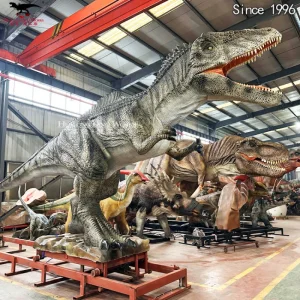
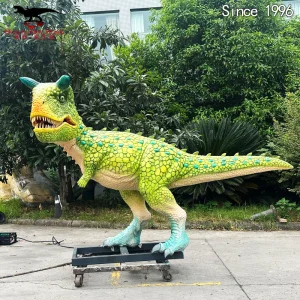
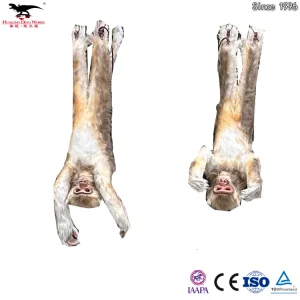
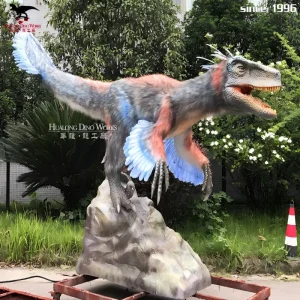
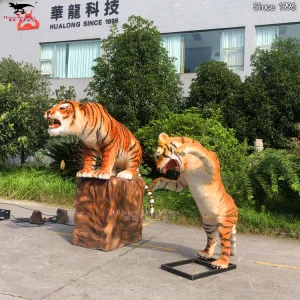
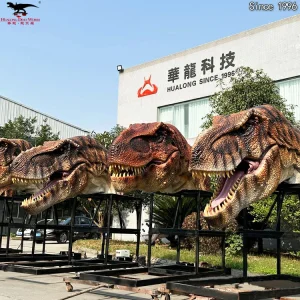
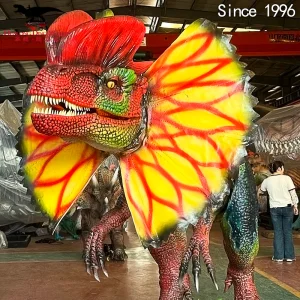
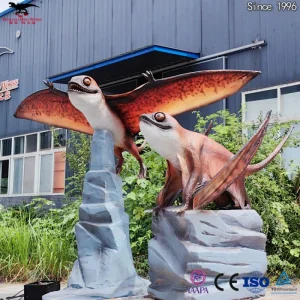
Extended Robotic Animatronics & Display Catalog
Comprehensive dynamic simulation units, kinetic props, and scenic biological models direct from our Zigong workshops.
Technical & Procurement FAQ
Critical engineering, structural safety, logistics, and verification details for institutional sourcing agents.