Prehistoric Fauna & Animatronic Core Engineering Showcase
Engineered for high-throughput public science centers, paleontological galleries, and immersive educational exhibitions. Fully compliant with CE, ISO9001, and international museum safety protocols.
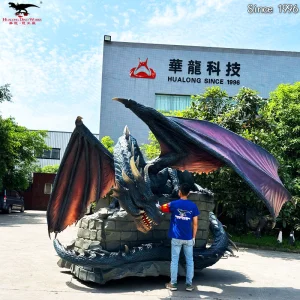
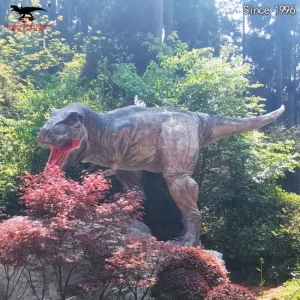
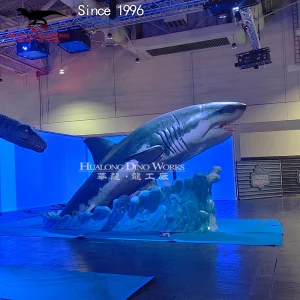
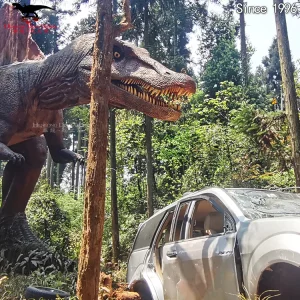

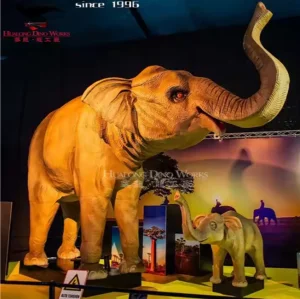
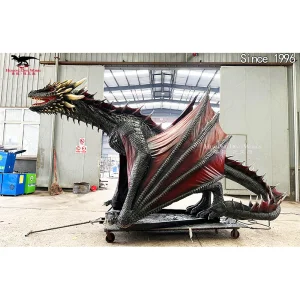
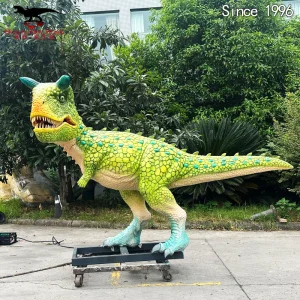
The Evolving Paradigm of Natural Science Museum Exhibits
In the twenty-first-century institutional landscape, natural history museums, planetariums, and scientific discovery centers face an unprecedented challenge: bridging the experiential gap between traditional static display cabinets and an increasingly digital-native public. The contemporary museum audience demands educational depth combined with sensory engagement. This fundamental shift has transformed the industrial design of natural science exhibits from rigid, taxidermic presentations into cybernetically sophisticated, bio-mechanically precise kinetic installations.
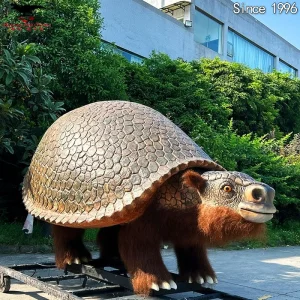
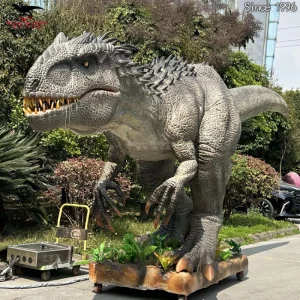
A natural science museum exhibit is no longer an isolated artifact; it is an engineered learning node. Whether reproducing the osteology of a Late Cretaceous Tyrannosaurus rex, sculpting the subcutaneous tissue of a Pleistocene megafauna specimen like the Glyptodon, or simulating oceanic ecosystems featuring hyper-realistic apex predators, modern fabricators operate at the rigorous intersection of comparative anatomy, mechatronics, material chemistry, and interpretive narrative architecture.
Core Engineering Tenet: Natural science museum-grade manufacturing differs categorically from novelty theme-park props. Museum curators, academic paleontologists, and institutional researchers require sub-millimeter anatomical fidelity, peer-reviewed skeletal articulation, archival material stability, and silent mechanical operation designed for 10-to-12-hour continuous daily duty cycles across decades.
Achieving this level of curatorial excellence requires direct collaboration between factory engineering teams and institutional stakeholders. By consolidating casting, mechanical framework articulation, servo-drive integration, and micro-texture silicone skin finishing under one specialized manufacturing complex, tier-one factories eliminate intermediary miscommunication, compress project execution timelines, and deliver verified scientific precision at unmatched economies of scale.
The Chinese Factory Advantage: The Zigong Industrial Cluster
Over 85% of the world's animatronic paleontological exhibits originate in Zigong, Sichuan. Explore how this regional industrial cluster empowers global museums through localized technological density.
Paleontological Heritage
Zigong is globally recognized as the epicenter of the Middle Jurassic Dashanpu fossil formations. Decades of institutional collaboration with the Zigong Dinosaur Museum have nurtured generations of sculptors and anatomical technicians who work from actual bone bed excavations rather than speculative illustrations.
Vertically Integrated Supply Chain
Within a 30-kilometer radius, our production facilities source cold-drawn structural carbon steel, custom-wound brushless servomotors, industrial planetary gearboxes, high-grade damping polymers, and platinum-cure silicone rubbers. This localized verticality reduces fabrication lead times by up to 50% compared to Western assembly shops.
Competitive Capital Efficiency
Direct sourcing from our 50-acre production footprint yields an average 40% to 65% cost efficiency over domestic European or North American exhibition fabricators. This allows curatorial committees to reallocate capital toward interactive multimedia, digital telemetry, and specialized conservation spaces.
Engineering Architecture & Institutional Specification Matrix
A rigorous breakdown comparing standard entertainment props against museum-grade scientific fabrication.
| Engineering Parameter | Commercial Grade (Theme Parks / Malls) | Museum Grade (Hualong Science & Tech Standards) | Curatorial Benefit & Life Expectancy |
|---|---|---|---|
| Structural Framework | Standard welded hollow steel pipe; localized rust inhibition. | CNC-formed seamless structural Q235/Q345 carbon steel; full immersion anti-corrosion chemical treatment. | Structural integrity certified for 20+ years; zero deflection under continuous cyclic loading. |
| Kinematic Actuation | Standard brushed AC/DC motors with basic chain/sprocket linkage. | Brushless digital AC servomotors with harmonic gear reducers, closed-loop positional encoders, and silent planetary gear sets. | Near-silent operation (<42 dB), fluid natural movement without mechanical shudder; operational MTBF > 35,000 hours. |
| Musculature & Dermal Matrix | Standard polyurethane foam with low-density latex surface paint. | High-resilience open-cell viscoelastic polyether foam layered with multi-directional fiberglass composite flex-mesh and platinum-cure silicone. | Resistant to tear propagation, ozone degradation, UV fading, and repeated touch-screen/tactile public interaction. |
| Paleo-Anatomical Accuracy | Exaggerated cinematic proportions; stylized teeth, scale patterns, and dynamic postures. | Peer-reviewed osteological proportioning; muscle-origin and insertion mapping; accurate claw/dentition topography confirmed by paleontologists. | Meets strict institutional peer-review standards for accredited international scientific collections and school curricula. |
| Control Architecture | Simple relay boards or analog loop timers. | Industrial PLC controllers, DMX512 communication, micro-second sync with multi-channel directional audio and LiDAR sensor triggers. | Seamless integration with central museum building management systems (BMS) and dynamic visitor-responsive scripting. |
Material Science in Kinetic Taxidermy & Bio-Simulation
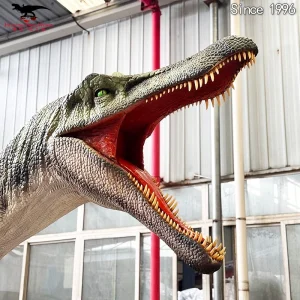
The illusion of life in a museum-grade exhibit is fundamentally rooted in material elasticity and refractive index matching. When building large-scale models such as the African Elephant or Spinosaurus, our chemical engineers formulate bespoke silicone elastomeric matrices with precise durometer hardness ratings (Shore A 10 to Shore A 25). This variation ensures that thin epidermal regions, such as ear flaps and eye membranes, flutter and crease naturally, while thick hide regions display realistic muscular resistance and resistance to tensile stress.
Furthermore, internal acoustic resonance is dampened using high-density polyether sound-deadening batting installed around internal drive cavities. This suppresses motor whine, gear lash, and electrical hum, ensuring the visitor hears only the programmed acoustic paleosonic profile or environmental ambient soundscape.
Macro Industry Solutions & Localized Spatial Deployment
Custom-engineered exhibition topologies configured for specialized architectural constraints, climatic conditions, and visitor interaction models.
Tier-1 Science Halls
Designed for multi-story atrium installations requiring custom ceiling-suspended steel anchorages, seismic load calculations, ultra-quiet zero-emission servo drives, and synchronized atmospheric theatrical lighting.
Interactive Science Centers
Reinforced for continuous hands-on visitor handling. Features heavy-duty mechanical linkages, touch-capacitive guest trigger plates, modular quick-swap electronic sub-assemblies, and low-voltage safe power supplies.
Botanical & Eco Biomes
Engineered for high humidity, misting cycles, and temperature swings. Features IP66-sealed electrical enclosures, non-hydrolyzing silicone formulations, and 316-grade stainless steel pivot hardware.
Touring & Traveling Shows
Engineered for rapid field assembly and teardown. Features segmented steel skeletons, quick-release multi-pin military aviation wiring plugs, and custom flight cases engineered for international sea/air containerization.
Global Museum Procurement & RFP Engineering Specifications
Essential validation criteria for Chief Curators, Technical Directors, and Municipal Procurement Committees when vetting factory partners.
Procuring natural science exhibits for municipal museums, universities, and accredited cultural institutions requires adherence to international engineering frameworks that exceed conventional commercial contracts. A comprehensive Request for Proposal (RFP) must address mechanical longevity, toxicological safety, fire resistance, and structural loading certifications.
Fire Retardancy & Toxicity
All internal cushioning materials, flexible coatings, and structural resins must comply with NFPA 701, DIN 4102 B1, or EN 13501-1 fire-behavior ratings, emitting zero toxic halogens or dense obscuring smoke in enclosed public spaces.
Electrical Certification
Complete control racks, internal servos, power converters, and thermal management units must possess factory-level CE, UL, or CSA markings, utilizing flame-retardant wiring harnesses with isolated surge protection.
Structural FEA Analysis
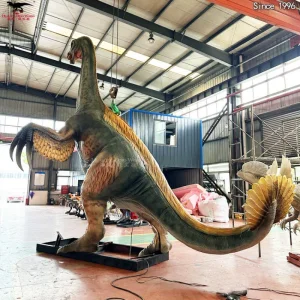
Large-scale cantilevered dynamic models (such as sauropod necks or rearing theropods) require Finite Element Analysis (FEA) to ensure safe anchoring to standard concrete floor slabs under seismic conditions.
Total Cost of Ownership (TCO) & Preventive Maintenance Cycles
A properly engineered natural science exhibit should yield a minimal 15-year institutional lifespan. When evaluating procurement bids, institutional directors must assess the Mean Time Between Failures (MTBF) of kinetic drive assemblies. Our factory supplies full engineering schematics, modular replacement gear units, pre-programmed interchangeable control modules, and 24/7 remote telemetry diagnostic support to ensure zero unplanned exhibition downtime.
Technological Frontiers: AI Kinematics, Sensor Fusion & Biomimicry
How cutting-edge computational engineering is transforming contemporary natural science exhibition fabrications.
LiDAR Guest Tracking & Dynamic Interaction
Replacing traditional passive infrared triggers with ceiling-mounted 3D LiDAR sensors that map crowd density and speed. The exhibit adapts its behavioral trajectory—shifting from calm respiration to territorial alerting as visitors approach.
Organic AI Kinematics
Say goodbye to mechanical repetition. Generative motion algorithms introduce subtle micro-variations into each kinematic sequence—minor eye twitches, irregular breathing tempos, and random weight shifts that eliminate artificial looping.
Eco-Friendly Sustainable Biopolymers
Advancing our sustainability targets with eco-conscious, zero-VOC waterborne silicone resins and recyclable internal polymer structural matrices, helping natural science institutions meet strict municipal carbon neutrality standards.
Frequently Asked Questions: Institutional Procurement & Manufacturing
Essential guidance for project directors, curatorial boards, and exhibition general contractors.
What verifies the scientific accuracy of your natural science museum models?
How does the factory manage sound emissions in quiet museum environments?
What are the lead times for custom-engineered museum centerpieces?
Do your exhibits comply with Western electrical and fire safety building codes?
What international shipping terms, packaging, and on-site assembly services do you provide?
Advanced Kinetic Specimens & Custom Diorama Engineering
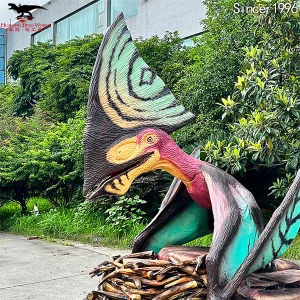
Expand your natural history collection with authentic Pleistocene fauna, articulated pterosaurs, and custom-sculpted Mesozoic exhibits.