
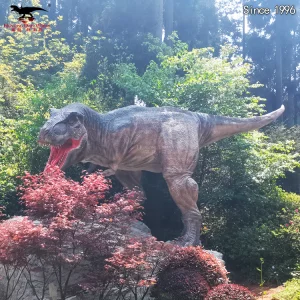
Direct-From-Factory Kinetic Displays & Festival Installations
Engineered for extreme environmental resilience, these flagship installations unify programmable lighting, biometric motion simulation, and industrial structural safety.
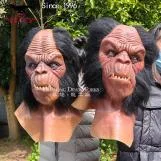
High-Quality Vampire Headwear - Amusement Park Interactive Prop
Explore Specs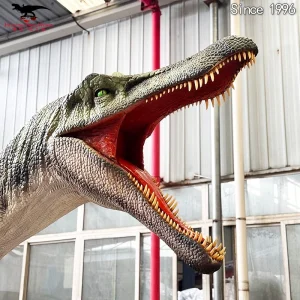
Custom Weatherproof Baryonyx Model Fish-Eating Dinosaur Sculpture
Explore Specs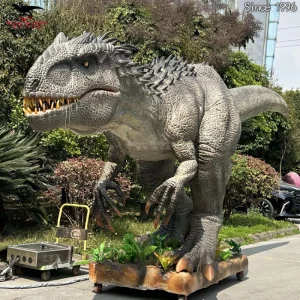
Animatronic Realistic Tyrannosaurus Indominus Theme Park Unit
Explore Specs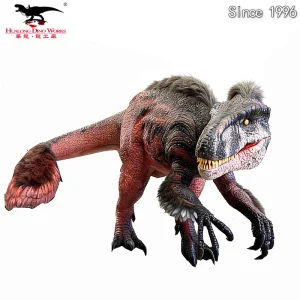
Museum Grade Custom Outdoor Waterproof Animatronic Dinosaur Models
Explore Specs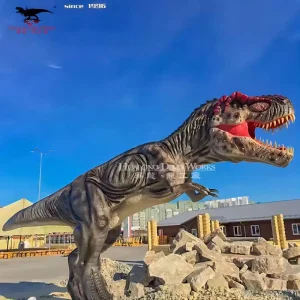
Aggressive Animatronic T-Rex Model for Theme Park Attractions
Explore Specs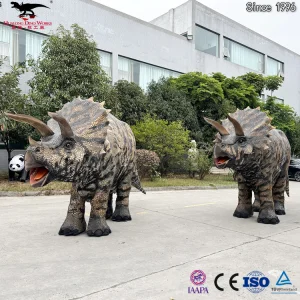
Fully Walkable Triceratops Costume with Dynamic Jaw Movement
Explore Specs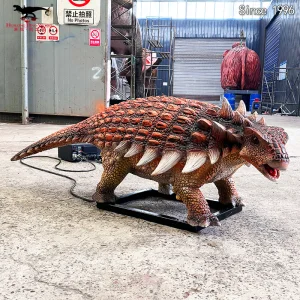
Weatherproof Ankylosaurus Foam Sculpture Theme Park Installation
Explore SpecsGlobal Market Status: The Nighttime Economy Revolution
Modern tourism economics require municipalities, cultural hubs, and theme parks to maximize non-daylight revenue per square meter through programmable illuminations.
Experiential Tourism Pivot
Global visitor destinations have transitioned from passive illumination toward deep narrative-driven spatial arts. Municipalities leverage festival lighting installations to transform dormant botanical zones and historic plazas into premium-ticket nocturnal experiences.
Convergent Mechanics & Light
The convergence of Zigong's millenary silk-and-wire lantern tradition with high-torque industrial servomotors has established a brand new industry standard: kinetic illuminated animatronics that function simultaneously as sculptures by daylight and living spectacles after dusk.
Procurement Risk Mitigation
Procuring festival installations directly from tier-one factories removes intermediary markups, ensures structural calculations adhere to international civil engineering codes, and gives developers complete authority over customized firmware programming.
China Factory Cluster Resilience & Zigong Heritage
Combining centuries-old handicraft guilds with the contemporary automation corridor of Sichuan's High-Tech Industrial Zone.
Full-Chain Cluster Sourcing
All core raw materials—high-tensile tubular carbon steel, high-density viscoelastic cellular foam, fluorosilicone elastomers, and custom micro-controllers—are sourced within a 45km factory radius.
TIG/MIG Structural Framework
Frames are fabricated via automated gas-shielded arc welding, subjected to triple-phase anti-corrosion immersion, and built to survive coastal saline spray conditions without oxidative decay.
Direct-to-Buyer Economics
Factory-direct procurement structures completely bypass wholesale agents, decreasing acquisition capital expense by 30% to 45% while preserving project budgets for high-impact customized show control.
Continuous 48-Hour Burn-In
Every electrical harness, LED circuit, and motor chassis completes mandatory 48-hour continuous lifecycle stress-testing prior to crating, virtually eliminating on-site deployment failures.
Global Deployment Matrices & Localized Use Cases
Engineered to adapt across multiple microclimates, operational demands, and regulatory environments.
Nordic Winter Walkways
Designed for sub-zero alpine conditions down to -35°C. Features internal PTC low-temperature thermodynamic trace heaters to preserve oil viscosity in reduction gearboxes and internal LED silicon arrays.
Monsoonal Tropical Trails
Sealed with IP68 conformal coatings over every electronic control unit (ECU) and multi-tier silicone skin vulcanization to withstand high humidity, torrential deluges, and fungal growth in equatorial regions.
Middle Eastern Desert Centers
Equipped with dual-stage dust filtering that complies with IP65 particle exclusion, along with reflective, heat-resistant topcoats that resist thermal degradation in environments reaching +55°C.
Technical Specification & Technology Roadmap (2025-2030)
Comprehensive baseline criteria for commercial project tenders and forward-looking engineering milestones.
| Engineering Subsystem | Standard Production Specification | Next-Gen Roadmap Implementation |
|---|---|---|
| Structural Engineering | Q235 structural steel skeleton, hot-dip galvanized & rust-treated | High-strength lightweight aluminum-magnesium alloys & carbon ribs |
| Luminescence / Optoelectronics | Waterproof LED arrays, high CRI >90, RGBW individual pixel nodes | Micro-LED pixel mapping, ultra-low power gallium-nitride drivers |
| Drive & Kinematics | Brushless DC planetary gear-motors, copper windings, limit switches | Absolute-encoder industrial bus servos with closed-loop telemetry |
| Sensory & Control | Infrared sensors, RF remote trigger, automated timeline master | AI-driven LiDAR motion tracking, volumetric audience presence sensors |
| Skin Substrate | High-density composite foam with 3-layer cross-linked silicone | Self-healing, fire-retardant composite elastomers (UL94-V0 compliance) |
Direct Engineering Advisory: All control panels are equipped with integrated emergency safety stops, surge suppressors, and modular circuit isolation to prevent cascading power failures during unexpected inclement weather spikes.
Global Safety Certifications & Regulatory Compliance
Factory-level testing verifies seamless jurisdictional sign-off from municipal building code departments and health & safety auditors.
Electrical Grid Adaptability
Internal power transformation blocks auto-switch across North American (110V/60Hz) and European/Oceanic/Asian (220-240V/50Hz) grids. Components carry CE (LVD/EMC), UL 508A, and UKCA compliance ratings.
Structural Wind & Seismic Loads
Every foundation baseplate calculation is backed by Finite Element Analysis (FEA). Anchor assemblies resist wind forces up to Beaufort Scale 11 (sustained 110 km/h) without permanent deformation.
Material Toxicity & Flammability
Silicone skins, paints, and internal structural elements strictly comply with RoHS and REACH standards. All exterior fabrics pass NFPA 701, DIN 4102-B1, and ASTM E84 flame propagation thresholds.
Large-Scale Kinetic & Science Museum Models
Precision-sculpted prehistoric models and interactive fantasy installations designed for large-scale outdoor displays, immersive exhibitions, and public walkthroughs.
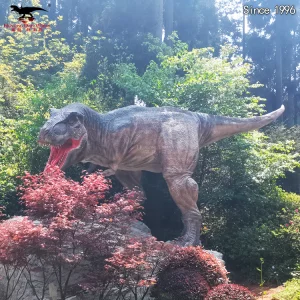
Zigong CE-Certified Waterproof Simulated Landscape Dinosaur
Explore Specs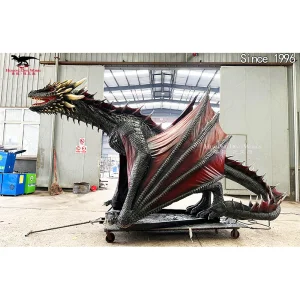
Life-Size Custom Electric Simulation Dinosaur Flying Dragon Diorama
Explore Specs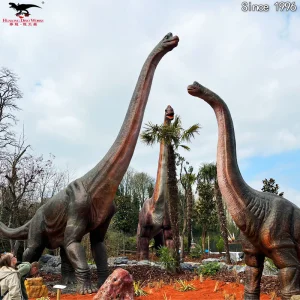
Custom Life-Size Largest Carnivorous Animated Dinosaur Exhibit
Explore Specs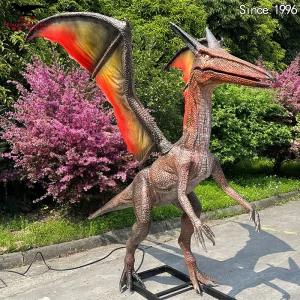
Weatherproof Mythical Winged Dragon Theme Park Exhibit Model
Explore Specs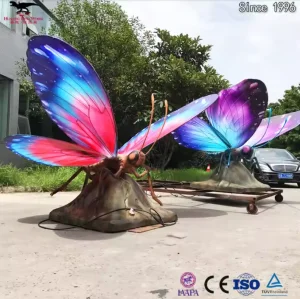
Interactive Animatronic Butterfly Exhibit with Flapping Wings
Explore Specs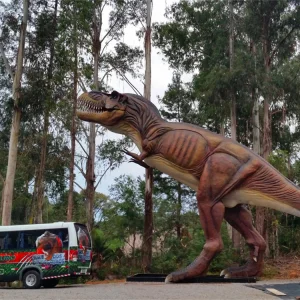
Lifelike Prehistoric Jurassic Replicas Realistic Animatronic Unit
Explore Specs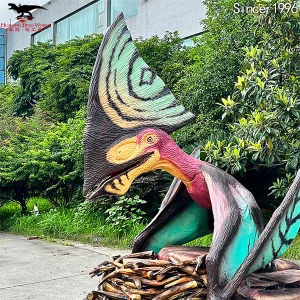
Moving Animatronic Pterosaur Robot with Silicone Skin & LED Eyes
Explore Specs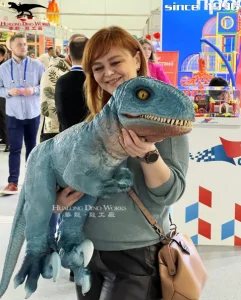
Wholesale Dinosaur Hand Puppets with Movable Jaw & Roaring Sound
Explore SpecsFrequently Asked Procurement & Engineering Questions
Essential technical clarifications for commercial development directors, municipal project managers, and logistics coordinators.
What are the standard production lead times for custom lighting installations?
Standard turnkey runs (5 to 15 major installations) require 30 to 45 business days for conceptual CAD design, frame fabrication, wiring, and 48-hour continuous load testing. Expedited schedules can be accommodated via parallel production lines at our 50-acre facility.
How are installations crated and protected for maritime freight?
Units are disassembled into modular sections, bubble-wrapped in shock-absorbing air-cushioning materials, sealed inside moisture-barrier plastic envelopes, and bolted within steel-reinforced fumigated wooden crates designed for ISO intermodal 40HQ containers.
Do you provide on-site electrical commissioning and structural assembly?
Yes. Our engineering deployment teams travel globally to oversee foundation anchoring, high-voltage cabling connections, structural alignment, and show-control synchronization. We also conduct comprehensive operator maintenance training prior to grand openings.
Can your systems integrate with standard lighting consoles (DMX512 / Art-Net)?
All factory control systems support standard DMX512 and Art-Net network protocols. This allows our dynamic light patterns and servo kinematic sequences to synchronize seamlessly with your park's broader show control system, soundscape, and special effects infrastructure.